Shopify B2B & Wholesale: The Complete Guide for US & UK D2C Brands (2026)
Why D2C Brands Are Adding B2B in 2026
The D2C playbook of 2020 — burn cash on Meta ads, acquire at any cost — is dead. In 2026, customer acquisition costs in the US have hit $45-85 per customer. In the UK, £30-65. Meanwhile, wholesale orders come with near-zero acquisition cost. A single trade show conversation or a cold outreach email can land a retailer who orders $5,000-50,000 of product — and reorders quarterly.
Here's the math that's changing minds: a D2C brand spending $50,000/month on Meta ads might acquire 1,000 customers at $60 AOV — $60,000 in revenue. The same brand landing 20 wholesale accounts at $3,000 average order value, with zero ad spend, generates $60,000 in revenue with 70-80% gross margins because wholesale isn't paying for performance marketing.
The smartest D2C brands in the US and UK aren't abandoning direct — they're layering B2B on top. And in 2026, Shopify Plus finally makes this seamless. One store, one product catalog, one admin — with a full B2B portal running alongside your D2C storefront.
Shopify Plus B2B: How It Works
Shopify Plus introduced the B2B channel as a native feature — not an app, not a workaround. Here's what you get out of the box:
The B2B Channel
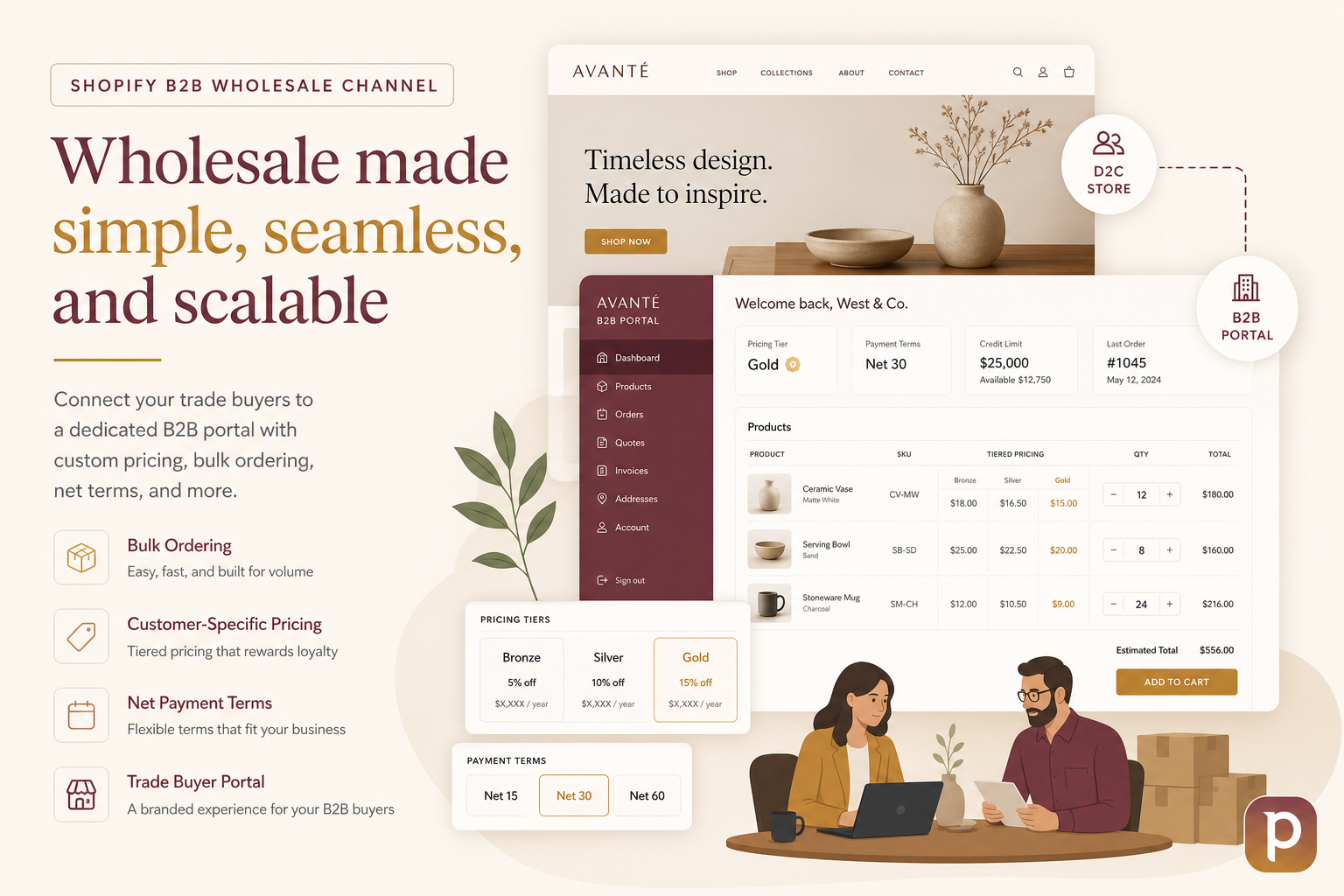
The B2B channel lives inside your existing Shopify Plus store. You don't build a second site. You create companies (your wholesale buyers) and tie each to a location and a catalog. When a buyer from that company logs in, they see wholesale pricing, bulk order forms, and net payment terms — all without affecting the D2C storefront that consumers see.
Companies & Locations
Each wholesale buyer is set up as a Company in Shopify. A multi-location retailer (say, a UK chain with 12 stores) can be one Company with 12 Locations — each with its own shipping address, billing address, and payment terms. Buyers at each location log in with their own credentials but share the company's catalog and pricing.
Catalogs & Pricing Lists
This is the killer feature. You can create multiple catalogs — a published set of products with custom pricing. Your standard catalog shows all products at D2C retail. A "Wholesale Tier 1" catalog shows the same products at 40% off retail. A "Wholesale Tier 2" catalog (for your top 20 accounts) shows 50% off with minimum order quantities. Each company is assigned the catalog that matches their negotiated terms.
Customer-Specific Catalogs & Pricing
Not every retailer gets the same deal. A national chain ordering 10,000 units expects different pricing than a single boutique ordering 50. Shopify Plus B2B handles this through catalogs and price lists:
| Tier | Discount Off Retail | Min Order Qty | Typical Buyer |
|---|---|---|---|
| Tier 1 — Stockist | 30-40% off | $500 minimum | Boutiques, salons, gyms |
| Tier 2 — Preferred | 40-50% off | $2,000 minimum | Regional chains, distributors |
| Tier 3 — Key Account | 50-55% off | $10,000 minimum | National retailers, export partners |
| Tier 4 — Private Label | Negotiated contract | Contract-based | White-label / OEM partners |
Each catalog can also exclude products. Maybe you don't want wholesale buyers stocking your limited-edition collaboration drops — exclude them from the B2B catalog entirely. Or perhaps a product has thin margins and you only offer it D2C — hide it from wholesale. The control is per-product, per-catalog, per-company.
Net Payment Terms & B2B Checkout
Consumers pay at checkout. Wholesale buyers don't. A boutique placing a $3,000 order expects net 30 or net 60 terms — they receive the goods, sell them over 30-60 days, then pay. This is non-negotiable in B2B, and Shopify Plus B2B supports it natively:
Payment Terms Options
- Net 15, Net 30, Net 60: Set per-company. The buyer places the order, you ship it, and payment is due X days after invoice.
- Pay on account: Buyers can place orders against an open account balance — useful for distributors who prepay a deposit and draw down.
- Immediate payment (credit card): For smaller accounts or first orders, require card payment before shipping. Move them to net terms after 3-5 clean orders.
- Custom terms: Negotiate whatever you need — net 45, 2/10 net 30 (2% discount if paid in 10 days), etc.
B2B Checkout vs. D2C Checkout
The B2B checkout is a different flow from your D2C storefront. Buyers see their negotiated prices, their shipping addresses (pre-loaded by location), and their payment terms. They can add a PO number (purchase order) to every order — critical for retailers who need to match invoices to internal POs. The checkout also supports quick order and reordering — a buyer can duplicate their last order with one click, which dramatically increases reorder frequency.
Bulk Ordering & the Wholesale Order Form
No wholesale buyer wants to click into 50 product pages to build an order. Shopify Plus B2B includes a bulk order form — a single page where buyers see the entire catalog in a table, enter quantities next to each SKU, and add everything to cart at once.
How the Bulk Order Form Works
- Variant-level ordering: Buyers enter quantities for each size/color variant directly in the table — no clicking into PDPs.
- Search & filter: Filter by collection, product type, or search by SKU. A buyer stocking 200 SKUs can build an order in 3 minutes.
- Quantity breaks: Set tiered pricing that activates automatically — "50+ units: 5% extra off, 100+ units: 10% extra off." Encourages larger orders.
- Quick reorder: One click duplicates the last order. Reorders are the lifeblood of wholesale — make them effortless.
- Save draft orders: Buyers can build an order over days, get approval from their team, then submit. Essential for larger retailers with procurement processes.
The bulk order form alone is why most D2C brands switching from email/Google Sheets to Shopify B2B see a 30-50% increase in wholesale order frequency. Friction kills reorders. Remove the friction and they order more often.
Wholesale vs. D2C Pricing Strategy
Pricing is where most D2C brands get B2B wrong. You can't just slap 40% off your retail price and call it a wholesale catalog. Here's a framework:
Margin Math
Wholesale pricing must protect your gross margin while leaving the retailer enough margin to be worth their shelf space. The standard split:
- Your COGS: 25-35% of retail
- Your wholesale price: 50-60% of retail (your gross margin = 25-35% of retail)
- Retailer's sell price: 100% of retail (retailer's gross margin = 40-50% of retail)
If your COGS is too high to support a 50% wholesale discount, you have a margin problem — not a B2B problem. Fix the product economics first. Most healthy D2C brands can support 40-50% wholesale discounts; if you can't, wholesale will erode your profitability.
MAP Pricing (Minimum Advertised Price)
This is critical in both the US and UK. MAP pricing is the lowest price a retailer is allowed to advertise your product at. You sell to them at wholesale; they agree not to advertise below MAP. This protects your D2C price integrity — you don't want a retailer undercutting your own $60 retail price at $42 and cannibalizing your direct sales.
In the US, MAP is enforced through your wholesale agreement and is legally straightforward. In the UK, MAP is more nuanced under competition law — you can set a recommended retail price (RRP) but cannot legally compel retailers to sell at it. Frame your UK agreements as RRP guidance, not hard floors.
Trade Shows & the B2B Sales Motion
Wholesale is not performance marketing. It's relationship sales, and trade shows remain the #1 acquisition channel. Here's how US and UK D2C brands use them:
US Trade Shows
- ASD Market Week (Las Vegas): The largest US wholesale show. 30,000+ buyers across categories. Budget $15,000-40,000 for a booth, travel, and samples.
- NY NOW (New York): Gift, lifestyle, and home. Strong for premium D2C brands targeting boutiques.
- Surf Expo (Orlando): Apparel, board sports, coastal lifestyle.
- Natural Products Expo West (Anaheim): Food, beverage, supplements, natural beauty.
UK & European Trade Shows
- Top Drawer (London): The UK's premier gift and lifestyle trade show. Runs twice yearly (January and September).
- Pure London (Olympia): Contemporary fashion and accessories.
- Spring Fair (NEC Birmingham): The UK's largest retail trade show — 60,000+ buyers across gift, home, and lifestyle.
- Maison&Objet (Paris): For brands targeting premium European retailers and concept stores.
Trade Show Conversion: Show → Order
A trade show gets you conversations. Converting them to orders requires the right post-show motion:
- Capture at the booth: Scan buyer badges to create a Shopify Company record on the spot. Set their catalog tier based on the conversation.
- Follow up in 48 hours: Send a personalized email with a link to your B2B portal — "Your account is ready. Here's your wholesale pricing. Place your first order here."
- Ship samples first: For larger accounts, send a sample box before asking for a $5,000 order. The conversion rate on sampled accounts is 3-4x higher.
- Set a first-order incentive: "Free shipping on your first wholesale order" or "10% extra product on first order." A one-time break that builds the relationship.
- Quarterly check-ins: Wholesale dies without relationship maintenance. A quarterly email or call — "How are the products selling? Need a restock?" — is what turns one-time buyers into repeat accounts.
The B2B Portal Experience
What your wholesale buyers see when they log in matters. A clunky portal signals a clunky brand. The Shopify Plus B2B portal includes:
- Password-protected login: Buyers access the portal via a B2B login link — separate from your D2C storefront.
- Company-branded experience: Show the buyer's company name, their pricing tier, and their negotiated terms on every page.
- Order history & reordering: Full order history with one-click reorder. This is the single highest-ROI feature in B2B — reorders are where wholesale profitability compounds.
- Invoice download: Buyers can download PDF invoices with their PO number for accounting. Reduces your "can you resend the invoice?" support tickets to zero.
- Draft orders & approval workflows: Larger retailers have procurement teams. A junior buyer builds a draft order; a manager approves it; it then auto-submits. Shopify B2B supports this workflow natively.
US vs. UK: Wholesale Market Differences
The US and UK wholesale markets look similar but behave differently. Understanding these nuances is the difference between a B2B channel that scales and one that stalls:
| Factor | US Market | UK Market |
|---|---|---|
| Typical wholesale discount | 40-50% off retail | 35-45% off retail (tighter margins) |
| Payment terms expectation | Net 30 standard; Net 60 for chains | Net 30 standard; Pro Forma for new accounts |
| Minimum order value | $500-1,000 typical | £300-750 typical |
| MAP pricing enforcement | Legally enforceable via agreement | RRP guidance only — cannot compel |
| Dominant trade shows | ASD, NY NOW, Expo West | Spring Fair, Top Drawer, Pure London |
| B2B payment methods | ACH, wire, credit card, net terms | BACS, wire, credit card, net terms |
| VAT handling | Sales tax varies by state — exempt for resale | VAT at 20% — reverse charge for B2B intra-EU |
| Average wholesale AOV | $2,000-5,000 | £1,500-4,000 |
| Reorder frequency | Quarterly to monthly for active accounts | Quarterly typical; seasonal peaks |
Tax & Compliance
This is where US and UK diverge sharply:
- US resale exemption: Wholesale buyers provide a resale certificate (state-specific — e.g., California Form BOE-230). You don't charge sales tax on orders to verified resellers. Shopify B2B supports tax-exempt status per company.
- UK VAT: B2B orders within the UK include 20% VAT. For B2B sales to EU buyers, the reverse charge mechanism applies — the buyer accounts for VAT in their country, and you zero-rate the invoice. Shopify Plus handles VAT correctly per location, but you must verify each company's VAT number (via VIES for EU buyers).
- Invoice requirements: UK B2B invoices must include your VAT number, the buyer's VAT number, and the reverse-charge notation for cross-border EU sales. US resale invoices reference the buyer's resale certificate number.
Migration: Moving From Sheets & Email to Shopify B2B
Most D2C brands running wholesale today are doing it painfully — Google Sheets order forms, email threads, manual invoicing in QuickBooks, and a separate Shopify store (or worse, a different platform entirely) for wholesale. Here's the migration path:
- Audit your current accounts: List every active wholesale buyer, their current discount tier, their payment terms, and their annual spend. You'll find 20% of accounts drive 80% of revenue.
- Set up catalogs & price lists: Build 2-3 tiers in Shopify Plus. Map products to each catalog. Set minimum order values per tier.
- Create Company records: Import your active accounts as Companies. Assign each the correct catalog, location, and payment terms.
- Migrate historical orders: Use the Shopify API or an app (like Matrixify) to import past wholesale orders so buyers see full order history on day one.
- Onboard buyers in waves: Don't switch all 80 accounts in one day. Onboard your top 10 accounts first, run their first reorder through the portal, fix any friction, then roll out to the rest.
- Decommission the old process: Once all accounts are live on Shopify B2B, stop accepting orders via email and spreadsheets. The portal becomes the only way to order. Friction-free for them, automated for you.
Measuring B2B Success: The Wholesale Dashboard
Track these metrics monthly. B2B has different KPIs than D2C — longer cycles, larger orders, lower frequency:
- Number of active wholesale accounts (placed an order in last 90 days)
- Average wholesale order value (target: 5-10x your D2C AOV)
- Reorder rate (% of accounts who placed a 2nd+ order in 12 months — target: 60%+)
- Wholesale revenue as % of total revenue (healthy range: 20-40% for hybrid D2C/B2B brands)
- Days sales outstanding (DSO) — average days to collect on net terms (target: under 35 days)
- Wholesale gross margin — should be 10-15 percentage points lower than D2C but with no ad spend
- New accounts per month — tracks trade show and outreach ROI
Common B2B Mistakes to Avoid
- Pricing everyone the same: A boutique and a national chain are not the same buyer. Tier your pricing or you'll leave margin on the table with small accounts and lose big accounts to competitors who negotiate.
- Ignoring payment terms risk: Net 30 sounds fine until a buyer goes bankrupt at $15,000 outstanding. Run credit checks on accounts over $5,000. Start new accounts on pro forma (pay before ship) and earn net terms over time.
- No MAP enforcement: If you don't monitor and enforce MAP, retailers will race to the bottom and your D2C price looks absurd. Audit your retailers' advertised prices quarterly.
- Treating B2B like D2C: No abandoned cart emails. No flash sales. No influencer discounts. B2B is relationships and consistency. Erratic marketing confuses wholesale buyers.
- No reorder motion: The first order is the hardest. If you don't actively drive reorders, 60% of accounts go dormant within 6 months. Build a quarterly outreach cadence into your process.
- Underestimating logistics: Wholesale orders are larger — pallet quantities, not parcel. Ensure your 3PL or warehouse can handle B2B fulfillment (pallet shipping, LTL freight, case packs) alongside your D2C parcel shipping.
The Bottom Line
Wholesale isn't a side hustle — it's a second revenue engine that runs on relationships instead of ad spend. In 2026, with D2C acquisition costs at record highs, the brands diversifying into B2B are the ones building durable, defensible businesses. And Shopify Plus has finally removed the technical excuse — you can run D2C and B2B from one store, one admin, one inventory.
The brands that win the next decade of retail won't be the ones with the biggest ad budgets. They'll be the ones who built a wholesale channel their retail partners love — easy ordering, fair pricing, reliable terms, and zero friction. Start with your top 10 accounts. Build the portal. Land the trade shows. Then scale. Your second revenue engine is closer than you think.
Ready to Launch Your Wholesale Channel?
I help US and UK D2C brands set up Shopify Plus B2B — from catalog and pricing strategy to portal launch, trade show playbooks, and account onboarding. Let's build your second revenue engine.
Last updated: July 2026 | Author: Pravesh | pravesh.online