Shopify Email Marketing Automation: The D2C Flow Playbook for US & UK Brands (2026)
Why Email Automation Is the Highest-ROI Channel in 2026
The math is brutal and beautiful. In 2026, acquiring a new customer in the US costs $45-85. In the UK, £30-65. Meanwhile, emailing an existing customer costs effectively nothing — Klaviyo bills per email, not per click, and a well-segmented list sends to engaged subscribers only. The result: email automation generates $36-45 per recipient in revenue for top D2C brands, against a near-zero variable cost.
Yet most Shopify stores treat email as an afterthought. They install Klaviyo, sync the integration, send a monthly newsletter, and wonder why email accounts for 7% of revenue instead of 35%. The brands hitting 35% have done something different: they've engineered flows around the customer journey, segmented aggressively, and treated email like a product — with roadmaps, testing, and iteration cycles.
The shift from "we send emails" to "email is a revenue engine" is entirely about automation. Campaigns are manual. Flows are automated, triggered by customer behavior, and run forever once built. Get the flows right and email works while you sleep. Get them wrong and you're burning the one channel that compounds with every order.
The Core Flows: Your Automation Foundation
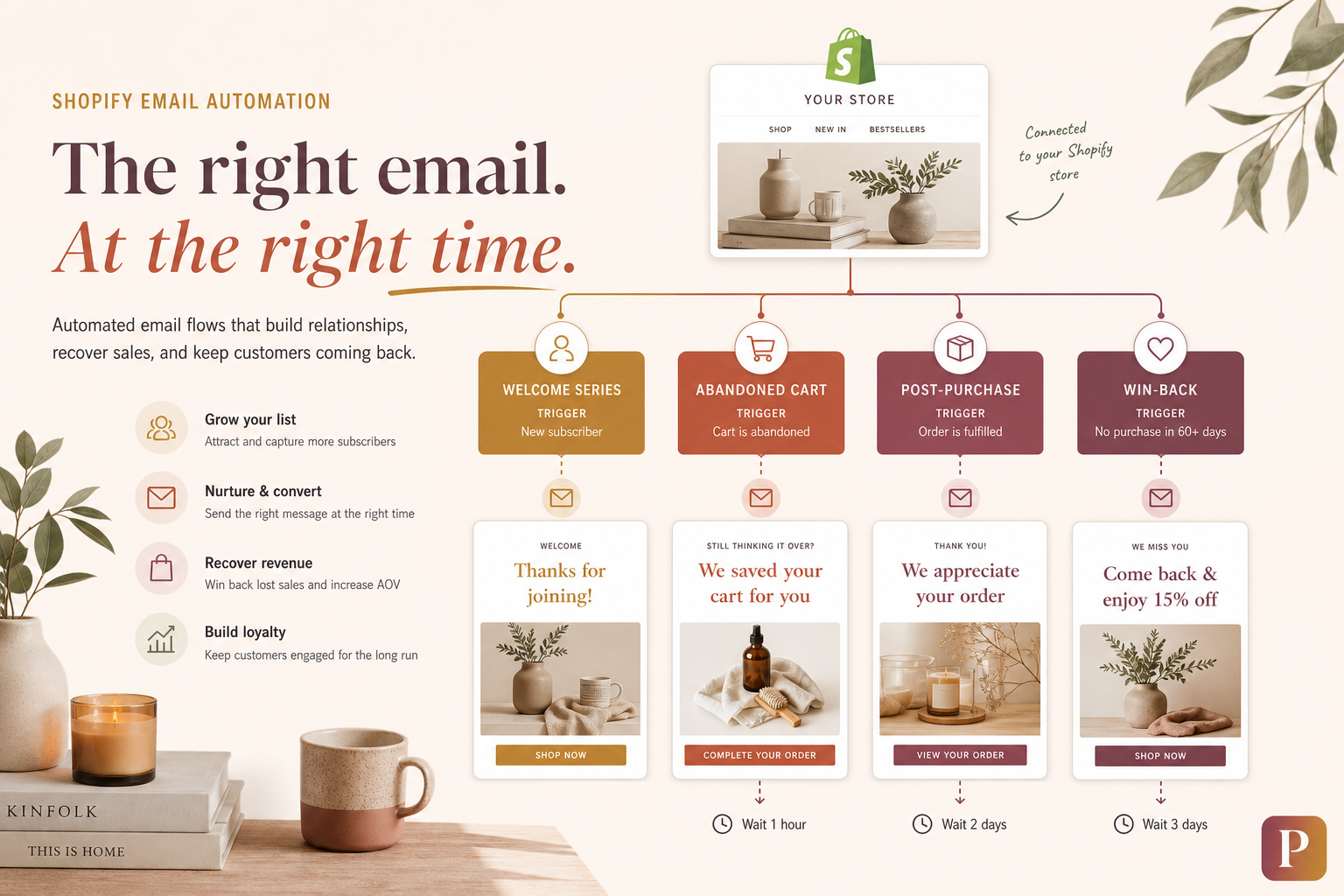
Every US and UK D2C brand needs the same five core flows. These account for 70-80% of email-attributed revenue. Build them first, optimize them forever.
| Flow | Trigger | Typical Revenue Share | Priority |
|---|---|---|---|
| Welcome Series | Email signup | 15-25% of email revenue | Build first |
| Abandoned Cart | Checkout started, not completed | 10-15% of email revenue | Build first |
| Abandoned Browse | Product viewed, no add-to-cart | 5-8% of email revenue | Build second |
| Post-Purchase Series | Order placed | 10-20% of email revenue | Build first |
| Win-Back Campaign | No purchase in 90-120 days | 5-10% of email revenue | Build second |
Flow 1: The Welcome Series (Your #1 Revenue Flow)
The welcome series is the highest-revenue flow in any D2C account. New subscribers are at peak intent — they just raised their hand. Convert them in the first 5 days or lose them for months.
The 4-Email Sequence
- Email 1 (Immediate): The discount delivery. "Here's your 10-15% off." Short, branded, single CTA to bestsellers. Don't bury the incentive in a story — give it up front.
- Email 2 (Day 2): Brand story + social proof. Why you exist, who you serve, what customers say. Include 2-3 reviews and a press logo strip. This builds the trust a first-time visitor doesn't have yet.
- Email 3 (Day 4): Bestsellers + category education. Show the 3-5 top products with a reason to care — "Why this serum has 4,000 five-star reviews." Educational copy converts better than a hard sell at this stage.
- Email 4 (Day 6): Urgency close. "Your 15% off expires in 48 hours." Real countdown, real deadline. This email typically drives 30-40% of welcome series revenue.
US vs. UK Welcome Series Nuances
- US: Discount-driven signups convert best. "15% off" outperforms "$15 off" and outperforms no-incentive capture by 3-4x. Lead with the dollar value.
- UK: Free shipping offers often outperform percentage discounts. UK consumers are highly shipping-sensitive — "Free shipping on your first order" can beat "15% off" by 20-30% in signup-to-purchase rate.
- Both markets: SMS + email opt-in together lifts capture rate by 40% but requires clear consent language. GDPR in the UK and CASL/state laws in the US mandate explicit opt-in — no pre-checked boxes.
Flow 2: Abandoned Cart Recovery
The abandoned cart flow is the most copied, most poorly executed flow in D2C email. Everyone has one. Almost no one has one that actually recovers carts. The difference is in the structure.
The 3-Email Recovery Sequence
- Email 1 (1-2 hours after abandonment): The "Did you forget something?" email. Product image, product name, single CTA back to checkout. No discount. Subject lines with the product name recover 15-20% more than generic "You left something behind."
- Email 2 (24 hours later): Social proof + objection handling. Add 2-3 reviews of the abandoned product, answer the top objection ("Free returns within 30 days"), and re-link to checkout. Still no discount.
- Email 3 (48 hours later): The incentive. 10-15% off or free shipping, expiring in 24 hours. This email recovers 40-50% of the carts that come back. Only send to users who haven't purchased — use a "placed order = 0 since flow started" filter.
What Kills Abandoned Cart Recovery
- Sending to customers who already bought. The #1 mistake. Add a "Placed Order = 0" filter to every email in the flow.
- No product image. Text-only cart emails recover 60% less than emails with the actual product photo and price.
- Discount in Email 1. Trains users to abandon on purpose. Hold the discount until Email 3.
- Long subject lines. Over 50 characters get truncated on mobile, where 70% of abandonment emails are opened.
Flow 3: Abandoned Browse (The Quiet Revenue Source)
Most brands stop at abandoned cart. But 60-70% of interested shoppers view a product, never add it to cart, and leave. The abandoned browse flow catches them. Trigger: viewed product, no add-to-cart, no purchase in the next 2 hours.
- Email 1 (2-4 hours): "Still thinking it over?" with the viewed product, a review, and 1-2 complementary products. Single CTA.
- Email 2 (24 hours): Bestsellers in the same category. Sometimes the viewed product wasn't right — give them alternatives.
Abandoned browse flows typically generate 5-8% of email revenue for brands that don't have them yet — pure incremental revenue.
Flow 4: The Post-Purchase Series
Most brands send one order confirmation and go silent. The post-purchase series is where repeat purchase rate is built — and where the best brands extract 2-3x more revenue from a customer who already trusts them.
The 4-Email Sequence
- Email 1 (Immediate): Order confirmation + what to expect. Shipping timeline, tracking link, how to use the product. Set expectations — this reduces support tickets and returns.
- Email 2 (Day 3-5): Product education + care. "How to get the most out of your [product]." Video tutorials, care guides, FAQ. This email builds the relationship that makes Email 3 work.
- Email 3 (Day 14-21): Review request. Sent after delivery — 7-10 days post-delivery for physical products. Offer an incentive for photo reviews ("15% off your next order for a photo review"). Photo reviews feed your PDP social proof, which improves conversion rate on the site.
- Email 4 (Day 30-45): Cross-sell or replenishment. If the product is consumable (skincare, supplements, coffee), trigger replenishment before they run out. If not, cross-sell complementary products based on what they bought. This email drives 25-35% of post-purchase revenue.
Replenishment Logic
For consumable products, build a replenishment flow that triggers based on the product's expected usage window. A 30-day skincare supply triggers a replenishment email at Day 22 — 8 days before they run out. This single flow can drive 15-20% repeat purchase rates for consumable D2C brands.
Flow 5: The Win-Back Campaign
Customers who haven't purchased in 90-120 days are at risk of churning forever. The win-back flow is your last shot — and it's surprisingly effective when engineered correctly.
The 3-Email Sequence
- Email 1 (Day 90): "We miss you" + a strong incentive. 15-25% off or free shipping, no expiration yet. Lead with new products or bestsellers they haven't seen — lapsed customers often haven't seen your last 3-6 months of releases.
- Email 2 (Day 100): New arrivals + social proof. "Here's what's new since you last visited." Show 4-6 new products with reviews. Lapsed customers are often surprised by how much has changed.
- Email 3 (Day 110): Final offer + urgency. "25% off, expires in 72 hours. After that, we'll stop emailing — we don't want to clutter your inbox." This is partly a real commitment: suppress non-openers after this email for 60-90 days. It protects deliverability and creates genuine urgency.
Win-back flows typically recover 5-10% of lapsed customers — at a fraction of the cost of acquiring a new one. The economics are unbeatable: recovering a lapsed customer costs $0.50-2.00 in email sends vs. $45-85 to acquire new.
Klaviyo Integration: The Engine Room
Klaviyo is the dominant email platform for Shopify D2C in both the US and UK — and for good reason. Its native Shopify integration syncs every event: product viewed, added to cart, checkout started, order placed, order fulfilled, order refunded. This event data is what powers behavioral flows.
Integration Checklist
- Shopify sync: Catalog, orders, customers, product reviews (via Yotpo, Okendo, or Judge.me integration). Every product event should flow into Klaviyo.
- Catalog feed: Enable Klaviyo's catalog sync so product blocks in emails auto-populate with live pricing, images, and inventory. No more manual product updates in emails.
- Review platform sync: Connect your review app (Okendo, Yotpo, Judge.me) so review requests can be triggered from Klaviyo and review data can segment customers ("left a 5-star review" → VIP segment).
- SMS enabled: Klaviyo's SMS is built in. Enable it with TCPA-compliant opt-in (US) and GDPR-compliant opt-in (UK). SMS flows generate 20-35% of Klaviyo-attributed revenue for brands that use both.
- Custom properties: Pass custom data from Shopify — subscription status, VIP tier, last order date, predicted next order date — into Klaviyo profiles for advanced segmentation.
Klaviyo vs. Alternatives
| Platform | Best For | Shopify Integration | Flow Builder |
|---|---|---|---|
| Klaviyo | Most US/UK D2C brands | Native, deep | Visual, behavior-based |
| Omnisend | Multi-channel (email + SMS + push) | Native | Visual, simpler |
| Sendlane | Cost-sensitive brands | Native | Visual |
| Mailchimp | Beginners only | Native but shallow | Limited behavior triggers |
| Braze | Enterprise ($10M+ revenue) | Custom | Enterprise-grade |
For 90% of US and UK Shopify D2C brands, Klaviyo is the right answer. Its Shopify integration is deeper than any competitor, its flow builder is the most flexible, and the ecosystem (templates, integrations, agencies) is built around it.
Segmentation: Where the Real Money Lives
Flows are the foundation. Segmentation is the multiplier. Sending the same email to your entire list is why most accounts capture 7% of revenue instead of 35%. Segmented campaigns generate 2-5x the revenue per recipient of batch-and-blast sends.
The 7 Core Segments
- VIP Customers (3+ orders or top 10% LTV): Your most profitable segment. Give them early access, exclusive products, free shipping — never discounts. VIPs don't want to feel marketed to; they want to feel valued.
- Recent First-Time Buyers (purchased in last 30 days): Cross-sell and education focus. Don't discount — they just bought. Build the relationship that drives the second order.
- Repeat Buyers (2+ orders, last 90 days): Loyalty drivers. New product launches, replenishment reminders, referral offers.
- At-Risk (last order 60-90 days ago): Pre-win-back. Gentle re-engagement — "We noticed you haven't been back" with new arrivals, no hard discount yet.
- Lapsed (last order 90-180 days ago): Win-back flow territory. Strong incentive required.
- Engaged Non-Buyers (opens/clicks in last 30 days, 0 orders): High-intent. Product education, social proof, and a first-purchase incentive.
- Disengaged (no opens in 60+ days): Suppress from regular sends. Protects deliverability for the entire account. Run a sunset flow every 90 days to clean the list.
Predictive Segmentation in Klaviyo
Klaviyo's predictive analytics assign every customer a "predicted next order date" and "predicted LTV" based on their purchase history and behavior. Use these to trigger replenishment flows before customers expect to need them, and to identify high-LTV customers early for VIP treatment. Brands using predictive segmentation see 20-30% higher flow revenue than those using static rules.
US vs. UK: Market-Specific Email Differences
The US and UK are the two most lucrative D2C email markets in the world, but they are not identical. What works in one can flop in the other. Here's what differs:
| Factor | US Market | UK Market |
|---|---|---|
| Discount sensitivity | Percentage discounts ("20% off") outperform | Free shipping and pound-value offers ("£10 off") often outperform |
| Email frequency tolerance | 3-5 emails/week acceptable | 2-3 emails/week is the sweet spot; higher频率 increases unsubscribes |
| SMS adoption | High — SMS drives 20-35% of Klaviyo revenue | Lower but growing; GDPR opt-in is stricter, hurting capture rates |
| GDPR compliance | CASL + state laws (CCPA, CPRA); opt-out model | GDPR — explicit opt-in required; no pre-checked boxes |
| Preferred payment mention | "Pay with Shop Pay, Affirm, or Klarna" | "Pay with Klarna, Clearpay, or PayPal" |
| Trust signals in email | BBB, money-back guarantee, free returns | Trustpilot reviews, free returns, Royal Mail delivery timing |
| Subject line length | 40-50 characters optimal | 35-45 characters; UK inboxes truncate earlier on mobile |
| Send timing | Tuesday-Thursday, 9-11am ET | Tuesday-Thursday, 9-11am GMT |
| Newsletter revenue share | 15-20% of email revenue | 20-25% — UK audiences engage more with editorial content |
Compliance: Non-Negotiable
One mistake here can sink your entire program. In the UK, GDPR requires explicit, opt-in consent — every subscriber must actively check a box or click confirm. No pre-checked boxes. No "implied consent." Keep proof of when and how each subscriber opted in. In the US, CAN-SPAM requires a working unsubscribe link and physical postal address in every email; state laws like CCPA/CPRA add data rights requirements. Klaviyo handles the mechanics — unsubscribes, suppression, physical address — but the consent capture at signup is your responsibility. Get it wrong and you lose the channel.
The Metrics That Matter
If you can't measure it, you can't improve it. These are the metrics that separate a 7%-of-revenue email program from a 35%-of-revenue one. Track them monthly and benchmark against the D2C averages below.
| Metric | What It Measures | D2C Benchmark (US/UK) | World-Class Target |
|---|---|---|---|
| Revenue per recipient (RPR) | Total email revenue ÷ recipients | $0.15-0.30 | $0.50+ |
| Email-attributed revenue share | Email revenue ÷ total revenue | 15-25% | 30-40% |
| Flow revenue share | Flow revenue ÷ total email revenue | 30-40% | 60-70% |
| Welcome series conversion rate | Subscribers who purchase from welcome flow | 5-10% | 15-20% |
| Abandoned cart recovery rate | Carts recovered ÷ carts abandoned | 5-10% | 15-20% |
| Repeat purchase rate (90-day) | Customers who order again within 90 days | 15-25% | 30-40% |
| Deliverability rate | Emails reaching inbox (not spam) | 85-92% | 97%+ |
| List growth rate | New subscribers ÷ total list (monthly) | 3-5% | 8-10% |
| Unsubscribe rate | Unsubscribes ÷ delivered (per send) | 0.3-0.5% | Under 0.2% |
Two metrics deserve special attention. Flow revenue share tells you whether your automation engine is doing the work or whether you're depending on manual campaigns. If flows are under 50% of email revenue, you're leaving money on the table — build and optimize the five core flows. Deliverability rate is the silent killer: if your emails hit the spam folder, nothing else matters. Monitor it monthly via Klaviyo's deliverability dashboard or a tool like Mailgun's reputation checker. If it drops below 90%, clean your list immediately — suppress disengaged subscribers and run a sunset flow.
Advanced Tactics (Once the Core Is Built)
RFM Segmentation
RFM — Recency, Frequency, Monetary value — is the gold standard for customer segmentation. Score every customer 1-5 on each axis and create segments like "Champions" (5-5-5), "At-Risk" (2-3-4), and "Hibernating" (1-1-1). Build dedicated flows for each tier. RFM-segmented brands see 25-40% higher email revenue than rule-based segmenters.
Back-in-Stock Flows
When a product comes back in stock, notify everyone who viewed it, added it to cart, or signed up for a stock alert. This flow has the highest conversion rate of any automated flow — often 8-15% — because intent is proven and timing is perfect.
Price Drop Alerts
Trigger an email when a product a user viewed or carted drops in price. Conversion rates of 5-10% are typical. Pair with a limited-time window ("price drop ends Friday") for urgency.
Post-Purchase Upsell on Order Status Page
On the Shopify order status page, offer a one-click upsell — a complementary product added to the just-completed order without re-entering payment. This is a conversion-rate play more than an email play, but Klaviyo can trigger the offer based on what was purchased. Average uplift: 10-15% AOV increase on the order status page.
SMS + Email Orchestration
Don't send the same message on both channels. Use SMS for time-sensitive triggers — abandoned cart within 1 hour, flash sale launches, back-in-stock alerts. Use email for storytelling, education, and product discovery. Brands that orchestrate SMS and email (not duplicate) see 30-45% higher combined revenue than those running them in parallel.
The Build Order: Where to Start
If you're building email automation from scratch — or rebuilding a broken account — follow this order. Each phase compounds on the last:
- Week 1: Install Klaviyo, sync Shopify, set up consent capture (GDPR/CCPA-compliant), and build the welcome series. This alone can generate 15-25% of email revenue.
- Week 2: Build abandoned cart and abandoned browse flows. These recover lost revenue immediately — often $5,000-20,000/month for a mid-size D2C brand.
- Week 3: Build the post-purchase series. This is where repeat purchase rate is built — the metric that determines whether you have a business or a one-time transaction.
- Week 4: Build the win-back flow and segment your existing list into the 7 core segments. Begin sending segmented campaigns instead of batch-and-blast.
- Month 2+: Add advanced flows (back-in-stock, price drop, replenishment), implement RFM segmentation, and enable SMS. This is where you go from 15% to 35% of revenue from email.
The Bottom Line
Email marketing automation is not a campaign. It's infrastructure. The D2C brands earning 35-40% of revenue from email aren't smarter than you — they've just built the flows, segmented the list, and treated email like the revenue engine it is. Every flow you don't have is revenue you're giving back to paid acquisition. Every segment you don't send to is a customer you're ignoring.
In 2026, with acquisition costs at record highs in both the US and UK, the brands that win won't be the ones with the biggest ad budgets. They'll be the ones whose email engine prints revenue from the customers they already have — on autopilot, every day, while they sleep. Start with the five core flows. Segment aggressively. Measure relentlessly. Your email list is the highest-ROI asset in your business — and it's entirely within your control.
Ready to Turn Email Into Your #1 Revenue Channel?
I help US and UK D2C brands build, audit, and optimize Klaviyo email automation — from the five core flows to advanced RFM segmentation and SMS orchestration. Let's find where your email program is leaking revenue and engineer the flows that fix it.
Last updated: July 2026 | Author: Pravesh | pravesh.online