Headless Shopify: The Architecture Guide for US & UK D2C Brands (2026)
What Is Headless Shopify, Actually?
Traditional Shopify: your storefront (what customers see) and your backend (products, orders, inventory) are coupled together. The Liquid theme renders everything server-side. It's simple, fast to set up, but locked in — you can't deeply customize the frontend experience.
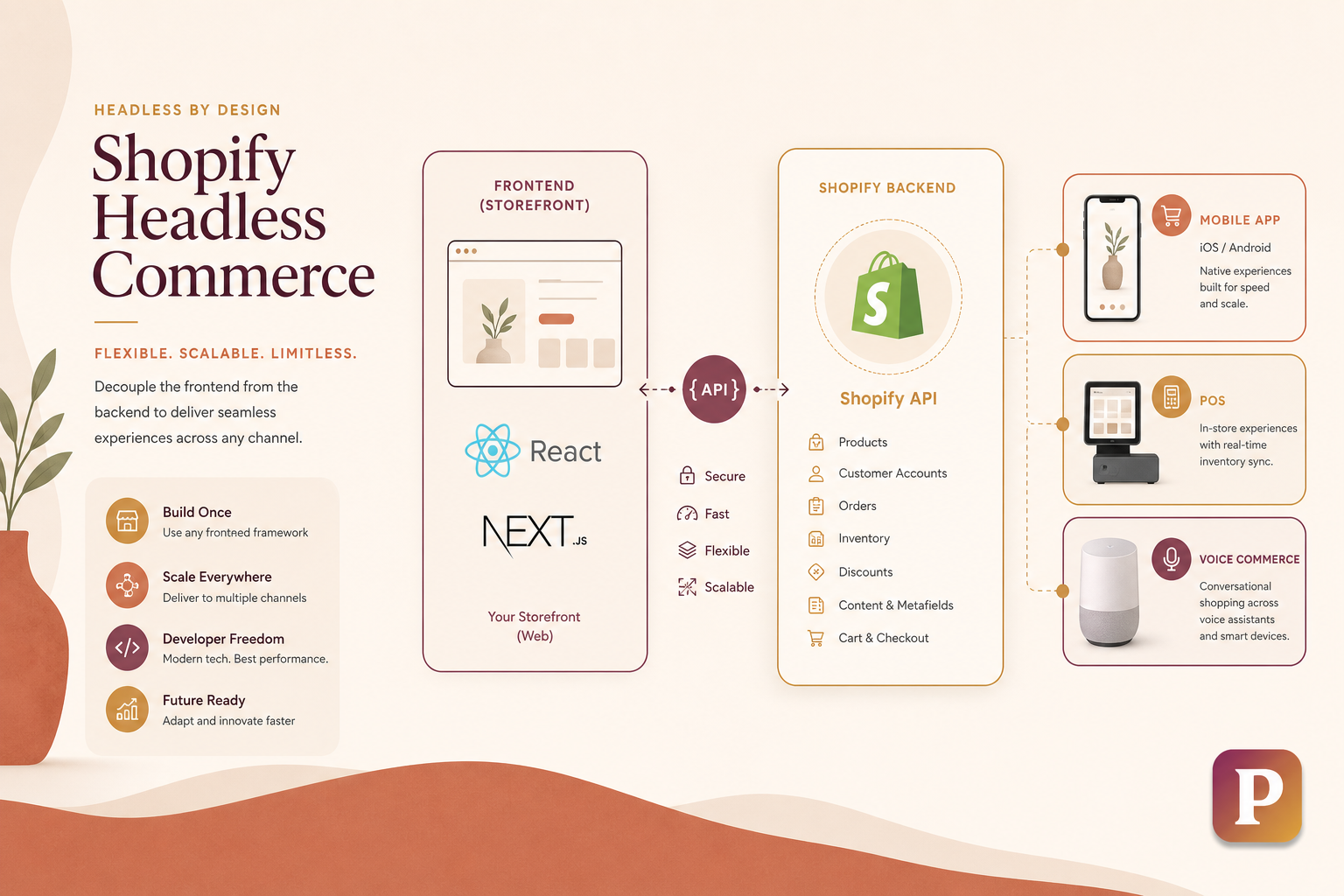
Headless Shopify: the storefront and backend are decoupled. Shopify's Storefront API delivers product data as JSON. Your frontend — built in React, Next.js, Vue, or any framework — consumes that data and renders the customer experience. You control every pixel. Shopify handles orders, inventory, payments, and checkout.
The trade-off: more frontend flexibility and performance, more development and maintenance overhead.
When to Go Headless (And When NOT To)
You Should Go Headless If:
- Your store does $5M+ annually — the development cost (typically $50K-150K) is justified by the revenue lift from speed and customization.
- Page speed is a bottleneck — if your Lighthouse score is under 50 and Liquid optimization has hit its ceiling, headless is the path to sub-1s loads.
- You need a custom UX — product configurators, AR/VR try-on, complex search, personalized experiences, multi-store architectures.
- You sell across non-web channels — mobile app, kiosks, voice commerce, smart displays. Headless lets you power all of these from one Shopify backend.
- You have a dev team (or budget for one) — headless requires ongoing maintenance. A Liquid theme can run for years without updates; a headless app needs monthly dependency updates.
You Should NOT Go Headless If:
- You're under $1M in annual revenue — the ROI isn't there. Spend the budget on CRO and acquisition instead.
- You don't have a developer — headless is a commitment. If you can't maintain it, you'll end up with a broken store and no way to fix it.
- Your current theme performs fine — if your Lighthouse score is 80+ and conversion rate is 2.5%+, the headless lift is marginal.
- You're launching a new store — validate product-market fit first. Don't invest in headless before you have product-customer fit.
- You need Shopify apps that depend on Liquid — many apps inject code into theme files. In headless, you need to rebuild their functionality custom or find API-compatible alternatives.
Architecture Options for 2026
1. Shopify Hydrogen (Official Headless Framework)
Shopify's own React-based framework, built on Remix. The recommended path for most brands.
- Pros: First-party Shopify support, optimized for Storefront API, built-in cart and checkout integration, hosted on Shopify Oxygen (free hosting).
- Cons: Learning curve if your team isn't familiar with Remix/React. Smaller ecosystem than Next.js.
- Best for: Brands that want Shopify-supported headless without custom infrastructure.
2. Next.js + Shopify Storefront API
The most popular custom headless stack. Next.js (React) frontend consuming Shopify's Storefront API.
- Pros: Huge ecosystem, tons of tutorials, Vercel hosting with edge functions, SSG/ISR for blazing-fast pages, works with any CMS.
- Cons: More custom setup than Hydrogen. You handle hosting, CI/CD, and updates.
- Best for: Brands with a React-savvy dev team that want maximum control and ecosystem.
3. Vue Storefront
Vue.js-based alternative. Popular in Europe, especially UK and Germany.
- Pros: Great DX, strong PWA support, works with multiple backends (not just Shopify).
- Cons: Smaller Shopify-specific ecosystem than React options.
- Best for: Brands already on Vue or wanting a multi-backend architecture.
4. Gatsby + Shopify
Static site generator approach. Best for content-heavy stores.
- Pros: Incredible page speed for content pages, great SEO, strong plugin ecosystem.
- Cons: Build times can be slow for large catalogs. Less suited for dynamic cart/checkout.
- Best for: Brands where blog/content is a primary traffic driver.
Performance: The Headless Advantage
| Metric | Liquid Theme (Optimized) | Headless (Hydrogen/Next.js) |
|---|---|---|
| LCP (Largest Contentful Paint) | 1.8-2.5s | 0.6-1.2s |
| FID (First Input Delay) | 100-200ms | 20-60ms |
| CLS (Cumulative Layout Shift) | 0.05-0.15 | 0.01-0.05 |
| Lighthouse score | 60-85 | 90-100 |
| Time to interactive | 2.5-3.5s | 0.8-1.5s |
What this means for revenue: Studies show that every 100ms of load time improvement increases conversion rate by 1%. Going from 2.5s to 1.0s = 15-25% conversion rate lift. At $1M monthly revenue, that's $150K-$250K in additional monthly revenue — well above the $8K-15K monthly cost of maintaining a headless store.
The Migration Playbook (3-6 Months)
Month 1: Architecture & Design
- Choose your stack: Hydrogen (Shopify-supported) or Next.js (max flexibility). Decide based on your team's expertise.
- Design the new storefront: This is where headless pays off — design the UX you couldn't build in Liquid. Custom PDPs, AR try-on, configurators, personalized content.
- API surface audit: Which Shopify APIs will you consume? Storefront API (products, cart), Customer API (accounts), Checkout API (checkout). Plan your data fetching strategy — SSG for catalog pages, SSR for cart/checkout.
- Hosting plan: Hydrogen → Shopify Oxygen (free). Next.js → Vercel ($20-200/month depending on traffic). Or self-host on AWS/GCP for enterprise.
Month 2-3: Build
- Build core pages: Home, PLP (product listing), PDP (product detail), cart, checkout, account, search.
- Integrate Storefront API: Product data, inventory, pricing, variants. Use GraphQL for efficient data fetching.
- Cart & checkout: Use Shopify's hosted checkout (redirect to checkout.shopify.com) or build a custom checkout with the Checkout API (Plus only). Most brands use hosted — it's PCI compliant and handles payment processing.
- SEO migration: Map every old URL to the new URL structure. Set up 301 redirects. Preserve canonical URLs. Use ISR (Incremental Static Regeneration) for catalog pages so they stay fresh without full rebuilds.
- Analytics & tracking: Re-implement GA4, Meta Pixel, TikTok Pixel, Klaviyo tracking. Headless breaks standard Shopify theme app embeds — you need to rebuild tracking in your frontend.
Month 4: Testing & QA
- Cross-browser testing: Chrome, Safari, Firefox, Edge. Mobile Safari is especially important — 30-40% of US/UK traffic.
- Performance testing: Lighthouse CI in your deploy pipeline. Every PR gets a performance score. Don't ship regressions.
- Checkout testing: Test every payment method, shipping zone, discount code, and customer scenario. Checkout bugs = lost revenue.
- SEO audit: Crawl the new site with Screaming Frog. Check every redirect, canonical, meta tag, hreflang (if multi-region).
Month 5: Launch & Cutover
- DNS cutover: Plan for low-traffic window. Keep the old Liquid store running in a staging environment for 30 days as a fallback.
- Monitor: Conversion rate, bounce rate, page speed, error rates, checkout completion. Any anomaly in the first 7 days gets immediate attention.
- Rollback plan: Know how to revert to the old store in under 1 hour if something breaks. DNS switch back to the old Liquid theme.
Month 6: Optimization
- Edge functions: Move personalization logic to the edge (Vercel Edge Functions or Cloudflare Workers) for sub-50ms personalization.
- Image optimization: Use next/image or Hydrogen's image component for automatic WebP/AVIF conversion and responsive sizing.
- Search: Integrate Algolia or Searchspring for instant, faceted search. Headless makes this much cleaner than Liquid.
- A/B testing: Set up VWO or Optimizely on the new frontend. You now have full control to test any element.
Cost Analysis: Headless vs. Liquid
| Cost Factor | Liquid Theme | Headless (Hydrogen/Next.js) |
|---|---|---|
| Initial build | $5K-30K (premium theme + customization) | $50K-150K |
| Monthly maintenance | $0-500 (updates handled by theme dev) | $3K-10K (dev team or agency retainer) |
| Hosting | Included in Shopify plan | $0-200/month (Oxygen free, Vercel $20-200) |
| App costs | $500-1,500/month (apps for features) | $200-800/month (fewer apps, custom built) |
| Annual total (year 1) | $20K-50K | $90K-250K |
Break-even: If headless delivers a 20% conversion rate lift (typical for brands moving from a 1.8% to 2.2%+ conversion rate), the additional revenue needs to exceed $70K-200K/year. For a brand doing $2M/year at 2% conversion, a 20% lift = $400K additional revenue. ROI is 2-4x in year one, and improves annually as maintenance costs stabilize.
Common Headless Pitfalls
- Underestimating maintenance: Headless isn't "set and forget." React updates, API changes, dependency vulnerabilities — budget for monthly maintenance.
- Breaking apps: Many Shopify apps inject Liquid code. In headless, you need to find API alternatives or rebuild functionality. Audit your apps before migrating.
- Checkout confusion: Most headless stores redirect to Shopify's hosted checkout. Don't build a custom checkout unless you're on Plus and need it — PCI compliance is serious.
- SEO regressions: If you don't map redirects and preserve URLs, you'll lose search rankings overnight. SEO migration is a first-class concern, not an afterthought.
- Analytics gaps: Standard Shopify analytics work, but third-party tracking (GA4, Meta Pixel) needs manual implementation. Missing tracking = flying blind on ad performance.
US vs. UK: Market Nuances
| Factor | US Market | UK Market |
|---|---|---|
| Headless adoption | Higher — larger dev ecosystem, more agencies | Growing — enterprise brands leading |
| Dev cost | $80-200/hr for React devs | £50-150/hr (£65-190/hr) |
| Hosting preference | Vercel dominant | Vercel + AWS Europe |
| Performance expectations | Sub-2s LCP expected | Sub-2s LCP expected (more demanding mobile users) |
| GDPR compliance | Limited — state laws (CCPA) | Strict — GDPR requires consent before tracking scripts load |
The Bottom Line
Headless isn't a luxury — it's a strategic decision with measurable ROI. For US and UK D2C brands doing $5M+ that have hit a ceiling with Liquid themes, headless delivers the performance and customization needed to break through. But it's not a decision to make lightly. The build cost is real, the maintenance is ongoing, and the migration is a 3-6 month project.
The brands that succeed with headless are the ones that treat it as a business investment with a clear ROI model — not a technical upgrade for its own sake. Map the revenue lift, budget the full cost (build + maintenance + opportunity cost), and execute with a proper migration plan. Done right, headless is the highest-leverage infrastructure decision a D2C brand can make in 2026.
Considering Headless Shopify?
I help US and UK D2C brands evaluate, architect, and migrate to headless Shopify — from feasibility assessment to Hydrogen/Next.js build, SEO migration, and post-launch optimization. Let's assess whether headless is right for your brand.
Last updated: July 2026 | Author: Pravesh | pravesh.online