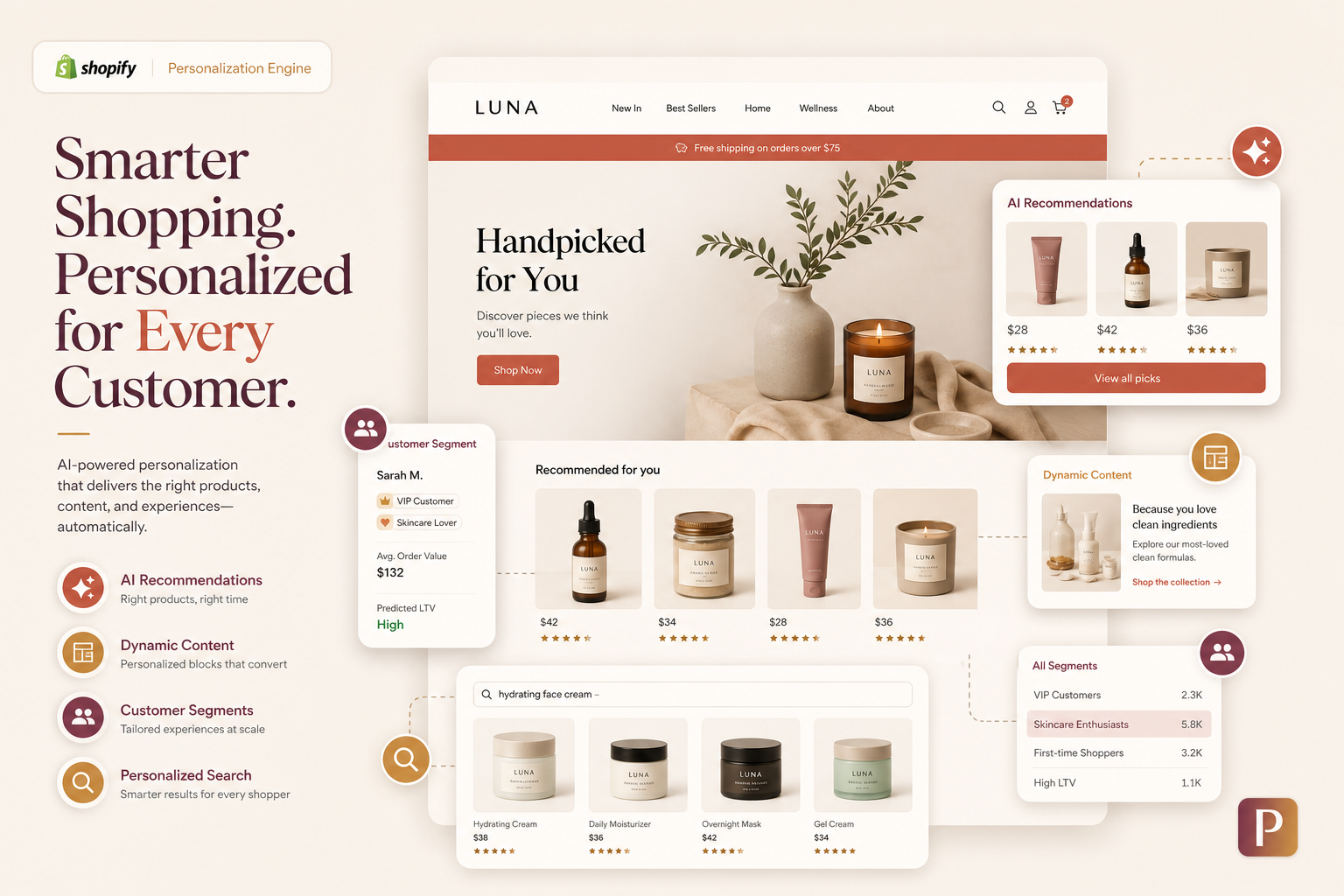
Shopify AI Personalization: The D2C Playbook for US & UK Brands (2026)
Why Personalization Is the Highest-ROI Lever in 2026
In 2026, the cost of acquiring a new D2C customer in the US sits between $45 and $85. In the UK, between £30 and £65. With paid acquisition at record highs, the brands pulling away from the pack aren't the ones buying more traffic — they're the ones extracting more value from the traffic they already have. Personalization is how they do it.
The data is unambiguous. McKinsey's research consistently shows that brands excelling at personalization generate 40% more revenue from those efforts than average competitors. For Shopify D2C brands specifically, the lift compounds: personalized product recommendations alone can account for 10-30% of total revenue, personalized search converts at 4-6x the rate of generic browsing, and personalized email/SMS flows drive 25-40% of repeat purchase revenue.
Yet most Shopify stores still ship a one-size-fits-all experience. Every visitor sees the same hero banner, the same collection order, the same "best sellers" widget populated by manual picks. That's leaving money on the table — and in 2026, with AI tooling built directly into Shopify and accessible via apps, it's also leaving competitive advantage on the table.
The Personalization Stack: Four Layers
Effective personalization isn't one feature — it's a stack. Each layer builds on the one below it. Skip a layer and the whole thing wobbles.
| Layer | What It Does | Typical Revenue Lift |
|---|---|---|
| 1. Data & Segments | Unified customer profile, real-time segments | Foundation — enables everything |
| 2. Product Recommendations | AI-driven "you may also like," "frequently bought together" | 10-30% of total revenue |
| 3. Dynamic Content | Banners, badges, copy, and offers tailored per segment | 5-15% conversion lift |
| 4. Personalized Search | Relevant results, synonyms, merchandising by intent | 4-6x conversion vs. browsing |
Layer 1: Customer Data & Segments
Personalization is only as good as the data behind it. Before you serve a personalized experience, you need to know who the visitor is — and Shopify gives you more signal than most brands use.
First-Party Data Sources on Shopify
- Order history: What they bought, when, how often, at what AOV. The strongest predictor of future behavior.
- Browse behavior: Products viewed, collections explored, time on PDP, search queries. Tracked via Shopify customer events or tools like Nosto and Dynamic Yield.
- Cart and wishlist: Abandoned carts, saved items, add-to-cart frequency without purchase.
- Account profile: Email, location, marketing opt-in, tags. Crucial for compliance (more below).
- Tech attributes: Device, referrer, landing page, geo-location (country/region level), new vs. returning.
Building Actionable Segments
Don't segment for the sake of it. Build segments you'll actually act on. These are the highest-value segments for US/UK D2C brands:
- New visitors: First session, no purchase history. Goal: build trust, capture email, showcase bestsellers and social proof.
- Returning non-buyers: 2+ sessions, no purchase. Goal: overcome hesitation — testimonials, guarantees, first-order discount.
- First-time buyers (0-30 days): Just purchased. Goal: onboarding, cross-sell complementary products, request review.
- Repeat buyers: 2+ orders. Goal: loyalty messaging, VIP perks, early access to new drops.
- VIP customers: Top 10% by LTV. Goal: exclusive products, free shipping, personalized concierge outreach.
- Cart abandoners: Added to cart, didn't purchase in 24 hours. Goal: triggered email/SMS with the exact item and an incentive.
- Geo segments: US vs. UK visitors. Goal: localized currency, shipping thresholds, payment methods, and compliance banners.
Shopify Segmentation Tools
- Shopify Segments (native, Plus): Build segments using order history, behavior, and customer tags. Sync to Shopify Email, Flow, and audiences for Meta/Google ads.
- Shopify Customer Accounts (new framework): Storefront personalization based on logged-in customer profile and order history.
- Metafields and tags: Enrich customer profiles with custom attributes — membership tier, skin type, fit preference — to drive granular personalization.
Layer 2: AI Product Recommendations
This is where most brands see the fastest, most measurable return. AI recommendations analyze behavior across your entire catalog and surface the right product to the right visitor at the right moment — without manual merchandising.
The Recommendation Placements That Convert
- Homepage "Recommended for You" carousel: Personalized for returning visitors based on browse and purchase history. For new visitors, fall back to trending bestsellers.
- PDP "You May Also Like": Complementary and substitute products. Drives cross-sell and keeps shoppers exploring when a product isn't the right fit.
- Cart drawer "Frequently Bought Together": The single highest-ROI placement. A $4 add-on to a $60 cart costs nothing in traffic and lifts AOV 8-15%.
- Post-purchase "Complete the Look" / "Pairs Well With": Drives repeat purchases and onboarding for new customers.
- Email/SMS product blocks: Personalized recommendations inside Klaviyo or Shopify Email flows. Browse abandonment, post-purchase, win-back.
Recommendation Strategies by Algorithm
Different placements need different logic. Here's how to map algorithm to intent:
| Algorithm | Best Placement | What It Optimizes For |
|---|---|---|
| Collaborative filtering ("customers also bought") | Cart, PDP | Cross-sell, AOV |
| Content-based ("similar to this product") | PDP, collection | Discovery, substitution |
| Trending / popularity | Homepage (new visitors) | Social proof, confidence |
| Recently viewed | Homepage, header | Reduce friction, return to intent |
| Personalized for you | Homepage, account page | 1:1 relevance, LTV |
Shopify Search & Discovery (Native)
Shopify's free Search & Discovery app handles the basics well — especially for brands under $5M revenue not ready to invest in a full personalization platform.
- AI-powered search relevance: Shopify's semantic search understands synonyms ("sneakers" = "trainers"), typos, and natural-language queries.
- Product recommendations: Native recommendation blocks for "related products" and "complementary products" on PDPs and cart — configurable in the theme editor, no code required.
- Custom synonyms and redirects: Map "jumper" to "sweater" for UK audiences, or redirect "gift" searches to curated collections.
- Faceted filtering: Size, color, price, material — the filtering that makes large catalogs browsable.
- Merchandising controls: Pin, boost, or hide products within search results. Essential for promoting high-margin or seasonal inventory.
For most D2C brands under $5M, Search & Discovery plus a well-structured theme covers 60-70% of the personalization opportunity. Don't over-engineer before you've mastered the native tools.
Layer 3: Dynamic Content
Recommendations personalize what you show. Dynamic content personalizes everything else — the banner, the headline, the offer, the social proof — based on who's looking.
Dynamic Content Tactics That Work
- Geo-personalized hero banner: US visitors see "Free shipping over $50." UK visitors see "Free shipping over £50 — next-day available." Same store, different first impression.
- Returning visitor welcome: "Welcome back, Sarah" with recently viewed products and a personalized recommendation carousel. Cuts browse time and signals that you know them.
- Segment-specific offers: New visitors see "10% off your first order." VIPs see "Early access to our new drop — thanks for being a loyal customer." One-size-fits-all offers leave margin on the table.
- Dynamic social proof: "4,200 reviews averaging 4.8 stars" for bestsellers. "Loved by customers in your area" for geo-personalization. Confidence at the point of hesitation.
- Cart abandonment dynamic blocks: If a customer left a specific product, the homepage on their return features that product with a "Still thinking it over?" badge and a review snippet.
- New vs. returning navigation: First-timers see "About Us" and "Why Choose Us" prominently. Returning buyers see "Your Orders," "Reorder," and "New Arrivals" first.
Layer 4: Personalized Search
Search is the highest-intent action on your store. A visitor who searches has told you exactly what they want. Personalized search makes sure they find it — fast — and merchandises results to maximize conversion and margin.
- Predictive search with images: As the user types, show product thumbnails, collections, and pages. Reduces time-to-product and lifts search conversion 20-40%.
- Synonym and typo tolerance: "Trainers" finds sneakers in the US catalog. "Bottle" finds water bottles and flasks. Native in Shopify Search & Discovery; deeper in Algolia or Nosto.
- Personalized result ranking: A returning customer searching "shirt" sees shirts in their size and previously browsed colors first. New visitors see bestsellers first.
- Merchandising rules: Boost high-margin products, pin seasonal hero products, hide out-of-stock variants. Combine with AI ranking for the best of both worlds.
- Search-driven recommendations: "Based on your search, you might also like…" surfaces adjacent products when the direct query has limited results.
Personalization Platforms: Nosto vs. Dynamic Yield vs. Native
Once you outgrow native Shopify Search & Discovery, you'll evaluate dedicated personalization platforms. Here's how the leading options stack up for US/UK D2C brands:
| Platform | Best For | Strengths | Pricing |
|---|---|---|---|
| Shopify Search & Discovery (native) | Brands under $5M rev | Free, native, fast setup, semantic search | Free |
| Nosto | D2C brands $2M-$50M | Deep Shopify integration, recommendations, dynamic content, on-site personalization, strong UK presence | From ~$200-2,000/mo |
| Dynamic Yield (Mastercard) | Brands $10M+, multi-store | Enterprise-grade segmentation, A/B testing, omnichannel, deep analytics | Custom (typically $2,000+/mo) |
| Algolia | Catalogs 500+ products | Best-in-class search speed and relevance, personalization add-on | From ~$1/mo usage-based |
| Klaviyo (CDP + AI) | Email/SMS-led brands | Unified CDP, AI predictions, 1:1 email/SMS personalization | From $35/mo, scales with contacts |
The right choice depends on revenue stage, catalog size, and where your personalization gaps are. A $3M brand with 80 SKUs is well-served by Search & Discovery plus Klaviyo. A $25M brand with 1,200 SKUs and a multi-region store needs Nosto or Dynamic Yield to manage the complexity.
Compliance: GDPR, CCPA, and the Privacy Stack
Personalization runs on customer data. In 2026, that data is regulated — and the regulatory landscape for US and UK D2C brands is only getting stricter. Get this wrong and you face fines, broken personalization, and lost trust.
GDPR (UK & EU)
- Consent before tracking: A visitor from the UK or EU must consent before non-essential cookies fire — including analytics, personalization, and retargeting pixels. Use a GDPR-compliant consent banner (Shopify's native, Cookiebot, or OneTrust).
- Explicit opt-in: Pre-ticked boxes are invalid. Consent must be a clear, affirmative action.
- Right to access and erasure: Customers can request all data you hold on them and demand deletion. Shopify's customer data portal and GDPR order deletion support this; document your process.
- Data Processing Addenda (DPAs): Sign DPAs with every tool that processes EU/UK customer data — Nosto, Dynamic Yield, Klaviyo, Meta, Google.
- UK GDPR vs. EU GDPR: Post-Brexit, the UK has its own GDPR regime. For brands selling into both, you'll need to handle EU and UK transfers lawfully (Standard Contractual Clauses) and respect both regimes' consent standards.
CCPA / CPRA (US — California, and growing)
- Right to know: California residents can request disclosure of what personal data you collect, sell, or share.
- Right to delete: Customers can request deletion of their personal data.
- Right to opt out of sale/sharing: A "Do Not Sell or Share My Personal Information" link in your footer. Even if you don't "sell" data in the traditional sense, sharing for cross-context advertising (retargeting) counts under CPRA.
- Expanding state laws: As of 2026, 15+ US states have privacy laws modeled on CCPA — Virginia, Colorado, Connecticut, Utah, Texas, Oregon, Montana, and more. A scalable compliance approach beats per-state patches.
Compliance Checklist for Personalization
- Implement a consent management platform (CMP) that blocks personalization scripts until consent is granted.
- Maintain a current privacy policy that explains what you collect, why, and with whom you share it.
- Ensure your personalization platform supports consent mode (Nosto and Dynamic Yield both do).
- Document data flows: which tools process which customer attributes, for what purpose.
- Offer a "manage preferences" option, not just an all-or-nothing consent.
- Honor deletion requests within 30 days (GDPR) or 45 days (CCPA).
A/B Testing Your Personalization
Personalization is a hypothesis, not a guarantee. "Showing returning visitors recently viewed products will lift conversion 8%" is a hypothesis. The only way to know is to test.
What to Test
- Recommendation placement: Cart drawer vs. PDP vs. post-purchase. Same algorithm, different surface — different lift.
- Algorithm: Collaborative filtering vs. content-based vs. trending. Let data decide, not your gut.
- Number of recommendations: 4 vs. 8 vs. 12 products. More isn't always better — choice overload is real.
- Dynamic content copy: "Welcome back" vs. "Still thinking it over?" vs. no greeting. Small copy, measurable lift.
- Personalized vs. generic offers: Does the VIP early-access message actually outperform the 15% discount? Test it.
Testing Tools & Methodology
- Dynamic Yield & Nosto native A/B testing: Built into the platforms. Test recommendations, banners, and page variants without touching code.
- VWO or Optimizely: For theme-level and cross-platform tests. VWO integrates cleanly with Shopify.
- Shopify A/B testing (Plus): Test product templates and checkout extensions natively.
- Statistical rigor: Minimum 1,000 conversions per variant, 2+ week duration, 95% confidence. No peeking, no early stopping.
Run one personalization test at a time per page. Stacking three personalization changes on the homepage makes it impossible to attribute the lift. Be disciplined — the compounding wins come from a clean testing sequence, not volume.
US vs. UK: Personalization Nuances
| Factor | US Market | UK Market |
|---|---|---|
| Compliance default | CCPA/CPRA opt-out model | GDPR opt-in model (consent required) |
| Currency & localization | USD, imperial units, US shipping thresholds | GBP, metric, £-threshold free shipping |
| Payment personalization | Shop Pay, Affirm (BNPL) prominent | Apple Pay, Klarna, Clearpay prominent |
| Trust signals | BBB, money-back guarantee, US press logos | Trustpilot, free returns, UK press logos |
| Consent banner | Lighter — often just a "Do Not Sell" link | Full consent banner with granular options |
| Language personalization | US English (color, favorite, shipping) | UK English (colour, favourite, delivery) |
| Personalization maturity | Higher adoption, more tooling budget | Catching up fast, privacy-first default |
Measuring Success: The Personalization Dashboard
Track these metrics weekly. Personalization should show measurable lift within 4-8 weeks of deployment:
- Revenue from recommendations — % of total revenue attributed to recommendation clicks
- Recommendation click-through rate — impressions → clicks
- Recommendation-to-purchase rate — clicks → purchases
- Personalized search conversion rate — searchers → purchasers vs. browsers → purchasers
- Average order value (AOV) — should rise as cross-sell takes effect
- Revenue per visitor (RPV) — the ultimate personalization metric
- Repeat purchase rate — personalization's long-game payoff
- Consent rate — % of visitors opting into tracking (a low consent rate starves personalization of data)
The Bottom Line
AI personalization on Shopify isn't a futuristic experiment — in 2026 it's table stakes for serious D2C brands in the US and UK. The tooling is accessible, the lift is measurable, and the brands deploying it are pulling 20-40% more revenue from the same traffic. The question isn't whether to personalize. It's how fast you can do it compliantly and systematically.
Start with native Shopify Search & Discovery and clean customer segments. Layer in recommendations on the PDP and cart drawer. Add dynamic content for geo and returning visitors. Graduate to Nosto or Dynamic Yield when revenue and catalog complexity demand it. Test everything. Respect the privacy laws — GDPR in the UK, CCPA in the US — not as a constraint but as a foundation for trust. The brands that get this right won't just convert better. They'll build the kind of customer relationships that compound for years.
Ready to Personalize Your Shopify Store?
I help US and UK D2C brands deploy AI personalization on Shopify — from native Search & Discovery setup to full Nosto/Dynamic Yield implementations, A/B testing programs, and privacy-compliant data strategy. Let's find your biggest personalization opportunities and ship them in weeks, not quarters.
Last updated: July 2026 | Author: Pravesh | pravesh.online