Shopify Subscription Revenue: Recurring Commerce Playbook for US & UK D2C Brands (2026)
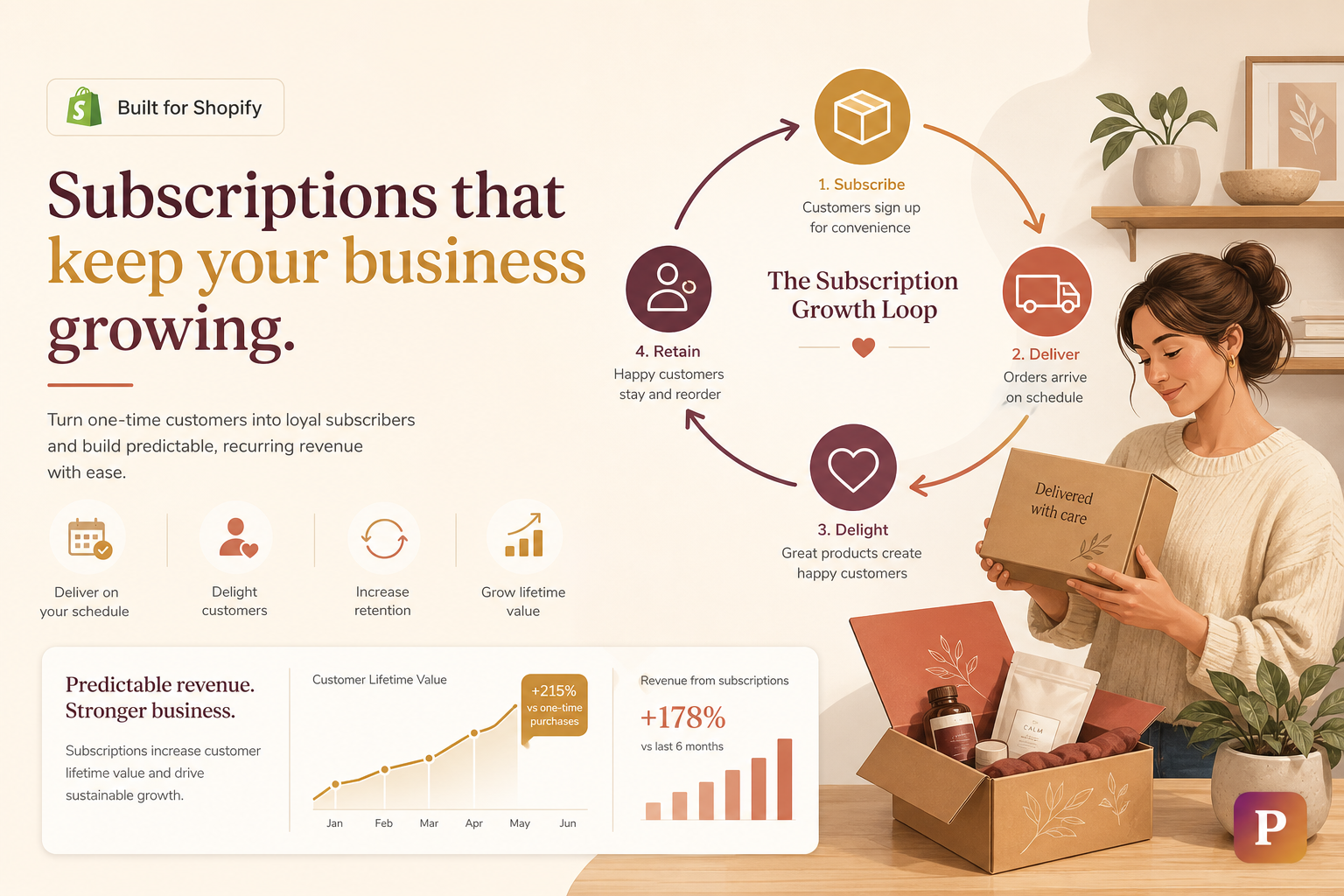
Why Subscriptions Are the Highest-Leverage Growth Strategy
Three numbers tell the story:
- Predictable revenue: Subscription businesses trade at 5-8x revenue multiples vs. 2-4x for transactional D2C. Investors love predictability.
- Lower CAC payback: A $50 CAC takes 1 order to recoup at $60 AOV. With a subscription, that CAC is amortized across 12+ months of revenue.
- Compounding retention: A 90% monthly retention rate means 50% of subscribers are still active after 7 months. The math compounds — and unlike ad-driven growth, it gets cheaper over time.
Choosing Your Subscription Model
Not every product fits the same model. Here are the four that work for US/UK D2C:
1. Replenishment (Consumables)
- Best for: Coffee, skincare, supplements, pet food, razor blades, contact lenses.
- How it works: Customer receives the same product (or a selected rotation) at a frequency they choose — monthly, bi-monthly, quarterly.
- Examples: Dollar Shave Club (razors), Ritual (supplements), Bumpin Blends (smoothies), Graze (snacks).
- Key metric: Average subscription length (target: 6+ months for consumables).
2. Curation (Discovery)
- Best for: Beauty, snacks, books, apparel, hobby supplies.
- How it works: Curated selection delivered monthly — the "surprise" is part of the value.
- Examples: Birchbox (beauty), Graze (snacks), Stitch Fix (apparel), Loot Crate (geek culture).
- Key metric: Churn after month 3 (if you retain past month 3, you've locked in long-term subscribers).
3. Access (Membership)
- Best for: Brands with a community, digital products, exclusive content, or member-only pricing.
- How it works: Subscribers pay for access — member pricing, free shipping, exclusive products, early access to drops.
- Examples: Amazon Prime (shipping + content), Sephora Beauty Insider (perks), Patagonia (worn wear program).
- Key metric: Member LTV vs. non-member LTV (should be 3-5x).
4. Hybrid (Subscribe + One-Time)
- Best for: Brands transitioning from transactional to recurring — which is most D2C brands.
- How it works: Offer both — "Subscribe & Save 15%" vs. "One-time purchase." Let customers self-select. Over time, convert one-time buyers to subscribers via post-purchase email flows.
- Key metric: Subscription attachment rate (% of orders that are subscriptions — target 25%+).
Setting Up Subscriptions on Shopify
Subscription Apps: 2026 Landscape
| App | Best For | Pricing (starts) |
|---|---|---|
| Recharge | Larger brands ($1M+ subscription revenue) | 1% + 10¢ per transaction |
| Skio | Modern D2C brands, migration-friendly | 1.25% + 8¢ |
| Ordergroove | Enterprise, complex retention logic | Custom pricing |
| Bold Subscriptions | Budget-conscious, simpler setups | $49.99/month flat |
| Shopify Native Subscriptions | Small brands, simple products | Free (via Shopify admin) |
Recommendation for US/UK D2C: Start with Recharge or Skio if you're serious about subscriptions. Shopify Native is fine for testing but lacks the retention features (dunning management, subscriber portal, swap logic) that make subscriptions profitable.
Key Setup Decisions
- Discount: 10-15% off is the sweet spot. Below 10%, adoption is low. Above 20%, margin erosion hurts. Test 12% as a starting point.
- Frequency options: Offer 3 choices — monthly, bi-monthly, quarterly. Don't overwhelm with 6 options. Default to monthly (most popular).
- Prepaid options: Offer 3-month, 6-month, and annual prepay. Prepaid subscriptions have 40% lower churn because the customer commits upfront.
- Subscriber portal: Let customers manage their subscription — swap products, change frequency, skip a delivery, pause. Self-service reduces support tickets by 60% and keeps subscribers active.
The Retention Playbook (Where Subscriptions Live or Die)
Acquisition is the easy part. Retention is the hard part — and the profitable part. Here's the system:
Month 1: Onboarding
- Welcome email sequence: 5 emails over 14 days — brand story, product education, usage tips, community invitation, feedback request.
- First delivery experience: The unboxing matters 10x more for subscriptions. Include a handwritten note, a sample of another product, a referral card.
- Usage nudge: If your product is a 30-day supply, send a "How are you enjoying it?" email at day 21 — before they've decided to cancel or continue.
- Community invitation: Invite to a private Facebook group, Discord, or WhatsApp community. Subscribers who join communities churn 30% less.
Month 2-3: Habit Formation
- Second delivery: Include a surprise — a new flavor, a sample, a full-size gift. The "surprise and delight" model is proven to reduce churn.
- Personalization: Let subscribers customize their box. "Choose 3 of these 6 products." Personalization reduces churn by 15-25%.
- Feedback loop: Post-delivery survey: "Rate your box 1-5. What did you love? What didn't work?" Use this data to improve future boxes.
- Loyalty integration: Award points for subscription longevity — "You've been a subscriber for 60 days. 200 bonus points unlocked."
Month 4-6: Deepening Commitment
- Upgrade offers: "Switch to a 6-month prepaid subscription and save an extra 10%." Prepaid subscribers have 40% lower churn.
- Add-on products: "Add this complementary product to your next delivery for 20% off." Increases AOV and deepens product engagement.
- Anniversary recognition: "You've been with us for 6 months! Here's a free gift in your next box." Loyalty that feels personal, not transactional.
- Exclusive access: Early access to new products, subscriber-only sales, or limited-edition variants. Status keeps subscribers engaged.
Month 7+: Defection Prevention
- Churn prediction: Use app analytics or Klaviyo to identify at-risk subscribers — declining engagement, skipped deliveries, support tickets.
- Save offers: When a subscriber tries to cancel, offer: 1) Pause instead of cancel, 2) Skip next delivery, 3) 20% off next box, 4) Switch to a different product. These save 15-30% of would-be cancellations.
- Win-back sequence: 3 emails over 2 weeks — "We miss you" + incentive, social proof (what they're missing), final offer with deadline.
- Exit survey: When they do cancel, ask why. The data is your roadmap for fixing the next cohort before they churn.
Dunning Management: Recovering Failed Payments
Up to 40% of subscription churn is involuntary — failed credit card payments. This is pure money left on the table.
- Retry logic: Recharge and Skio retry failed payments automatically — 3 retries over 14 days. This recovers 50-70% of failed payments.
- Email sequence: Send 3 dunning emails: Day 1 (friendly reminder), Day 5 (urgency — "Your subscription is on hold"), Day 10 (final — "Update your card to reactivate").
- SMS dunning: SMS has 5x the open rate of email. Add SMS reminders on day 3 and day 7. Recovers an additional 10-15%.
- Card updater: Stripe and Braintree offer automatic card updates — when a customer gets a new card, the network updates the token. This alone saves 5-10% of involuntary churn.
Metrics That Matter
| Metric | Target | Why It Matters |
|---|---|---|
| Monthly churn rate | <8% for consumables, <12% for curation | The single most important metric — everything else flows from this |
| Average subscription length | 6+ months | Short subscriptions don't amortize CAC |
| Subscription MRR | Growing 10%+ MoM | Healthy scaling — new subscribers outpace churn |
| Subscriber LTV | 5-10x non-subscriber LTV | Justifies higher CAC for subscription acquisition |
| Subscription attachment rate | 25%+ of orders | How many one-time buyers convert to subscriptions |
| Net revenue retention | >100% | Existing subscribers spend more over time (upgrades, add-ons) |
US vs. UK: Market-Specific Nuances
| Factor | US Market | UK Market |
|---|---|---|
| Subscription adoption rate | Higher — consumers are accustomed to subscription models (Amazon Prime, Dollar Shave Club) | Growing — Amazon Prime established the norm, D2C subscriptions following |
| Payment preferences | Credit card dominant — easy recurring billing | Credit card + direct debit (Bacs) — offer both |
| Churn tolerance | Higher churn tolerance — consumers subscribe and cancel freely | Lower churn tolerance — UK consumers expect more commitment |
| Average subscription value | $30-60/month | £20-45/month |
| Regulatory | Minimal — subscription auto-renewal is standard | EU/UK consumer law requires clear cancellation terms — be explicit |
The Bottom Line
Subscriptions aren't a revenue hack — they're a business model shift. The brands that win at subscriptions aren't the ones with the best acquisition funnels. They're the ones with the best retention systems. Onboarding, habit formation, community, dunning, churn prediction — these are the boring operations that separate a $100K/month subscription business from a $10M/month one.
Start with a simple model — subscribe and save on your top 3 products. Get 100 subscribers. Learn what makes them stay. Build the retention system. Then scale. The compounding starts slow, but by month 12, you'll wonder why you ever sold one-time-only.
Ready to Build Your Subscription Business?
I help US and UK D2C brands launch and optimize Shopify subscriptions — from model selection and app setup to retention automation and dunning optimization. Let's build your recurring revenue engine.
Last updated: July 2026 | Author: Pravesh | pravesh.online