How to Reduce Shopify Cart Abandonment for Indian Customers
Why Indian Cart Abandonment Is Different
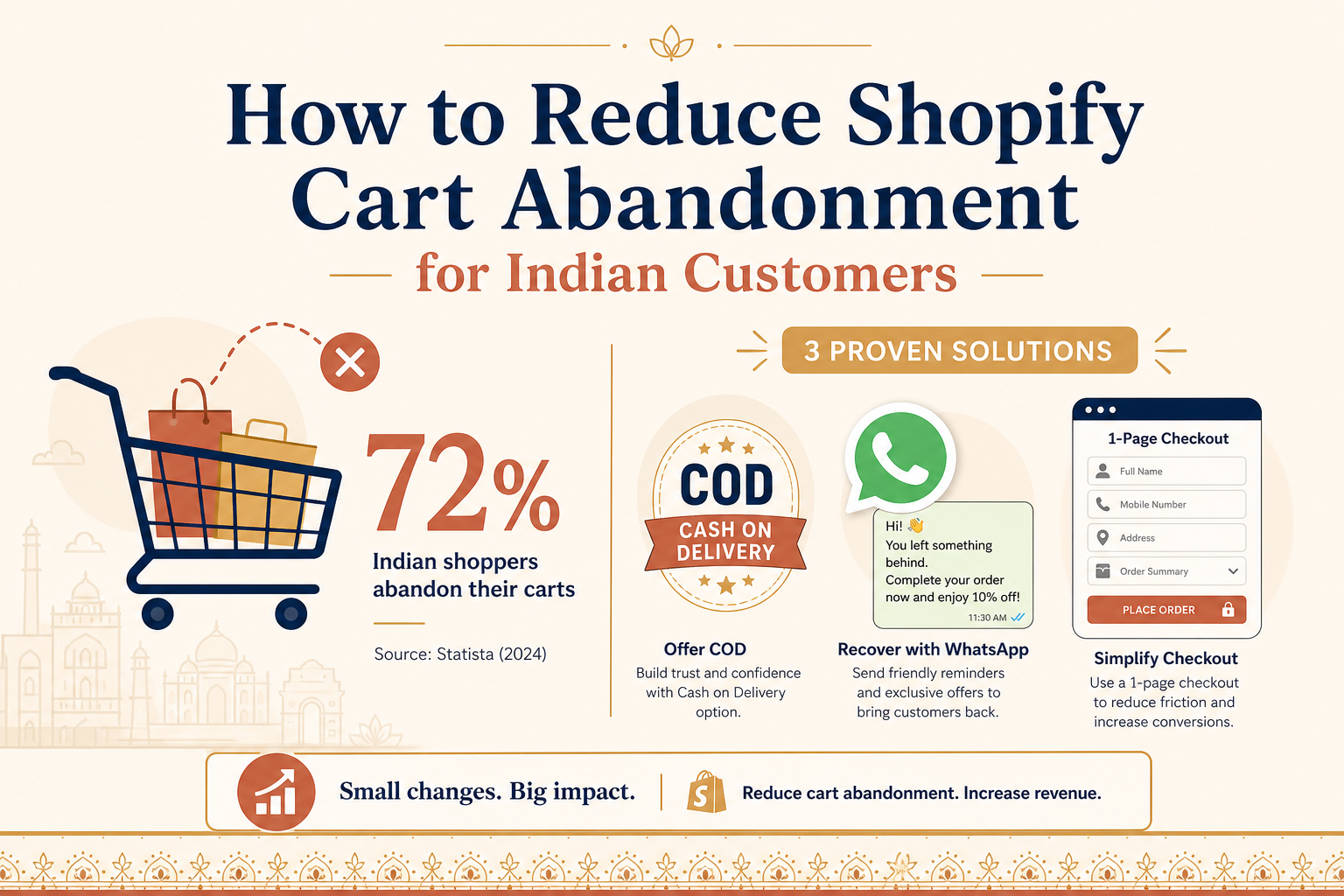
Cart abandonment is a global problem, but Indian ecommerce has unique friction points that drive rates even higher. Unlike Western markets where credit cards are the default, Indian shoppers navigate a complex mix of payment preferences — UPI, cards, netbanking, wallets, and predominantly Cash on Delivery (COD) which accounts for 65% of all online orders.
The most common triggers for Indian cart abandonment:
- Hidden costs at checkout — shipping fees, GST surprises, or "convenience charges" that appear only at the final step
- COD unavailability — if a store doesn't offer COD, nearly 40% of Indian shoppers will abandon immediately
- Too many checkout steps — multi-page checkouts with OTP verification, address forms, and payment redirects
- Trust deficit — unfamiliar payment gateways or missing trust signals (return policy, contact info, reviews)
- Comparison shopping — Indian shoppers open 5–7 tabs comparing prices before committing
6 Fixes That Reduce Cart Abandonment for Indian Stores
1. Show Final Price Upfront — No Surprises at Checkout
This is the single biggest reason Indian shoppers abandon carts. They add items to cart, proceed to checkout, and suddenly see ₹200 shipping or an unexpected 18% GST line item — and they leave.
2. Offer COD Prominently — And Make It Obvious
65% of Indian ecommerce orders are COD. If a shopper doesn't see a COD option, they assume it's unavailable and leave. But many stores bury the COD option behind payment gateway selections — by then, the shopper is already frustrated.
3. Simplify to a 1-Page Checkout
Every extra step in your checkout flow loses approximately 10% of customers. Indian checkouts often compound this with OTP flows, address verification popups, and payment gateway redirects that feel like separate steps.
4. Add Trust Signals Near the Buy Button
Indian shoppers are skeptical — and rightly so. Counterfeit products, delivery scams, and poor return experiences are common. Your checkout page needs to scream "you can trust us."
5. Exit-Intent Popup with a Discount
When a shopper's mouse moves toward the back button or close tab, an exit-intent popup can recover them. This works especially well in India where price sensitivity is high — a 10% discount is often enough to close the deal.
6. WhatsApp Cart Recovery — The Indian Superpower
Email cart recovery has a 2–5% success rate in India because most shoppers don't check promotional emails. But WhatsApp? Open rates are 90–98%. An abandoned cart WhatsApp message with the product image, price, and a direct checkout link converts 3–5x better than email.
Quick-Win Prioritization
If you can only implement two fixes this week, do these:
| Priority | Fix | Effort | Expected Impact |
|---|---|---|---|
| #1 | Add "COD Available" badge on product pages | 15 minutes | +8% conversion |
| #2 | WhatsApp cart recovery automation | 1 hour (app install + setup) | 15–20% cart recovery |
The Bottom Line
Indian cart abandonment is higher than global averages, but the fixes are straightforward — and they compound. A store that implements transparent pricing, visible COD, and WhatsApp recovery can realistically cut its abandonment rate from 72% to under 50% within 30 days.
That's not a marginal improvement — it's a 30%+ revenue uplift from the same traffic. And in the Indian ecommerce market where margins are thin and customer acquisition costs are rising, recovered revenue is the highest-ROI investment you can make.
Want to fix your cart abandonment problem?
I optimize Shopify checkouts for Indian stores — COD workflows, WhatsApp recovery, trust badges, and checkout UX. Most stores see a measurable conversion lift within the first week.
Get a Free Consultation →